Lead the Way SD is the world's first comprehensive "test and treat" model of HIV prevention. From now until the end of 2011, we want to have all adults in San Diego's 92103 and 92104 zip codes answer the following question:
"Would you or wouldn't you take an HIV test?"
Lead the Way has launched a mobile testing campaign to visit residential locations in the 2 zip codes and provide a 10-minute HIV test or a brief survey of why individuals would or wouldn't take the test. The storefront testing center is located at 3830 Park Blvd., on the corner of University and Park in Hillcrest, and will also offer free 10-minute finger prick HIV tests.
For more info visit: http://LeadTheWaySD.com http://facebook.com/LeadthewaySD http://twitter.com/LeadthewaySD
The MALE Condom Naturally, the more you use a condom, the more confident you'll become with putting it on. Practice alone or with your partner, It can be fun, loving, and sexy thing you can learn together.
Putting on a Condom
Carefully open the condom package at one corner being careful not to tear the condom with your fingernail, teeth or a sharp object.
Place the rolled condom over the tip of the hard penis. If there is no reservoir tip, pinch it to give it one and leave room to let semen collect.
If you’re not circumcised, pull back the foreskin before putting the condom on the head of your penis.
Pinching the air out of the condom with one hand (air bubbles can cause breakage), unroll the condom down the full length of your penis to the base with the other.
Make sure the condom is right side out. Unroll it a bit to see if it unrolls easily. If so, you’re doing it right. If not, try again with a new condom. You just need a little practice.
For anal intercourse, lube up! Put the lube on after you put on the condom. It can actually reduce breakage. Always use check lubricants to see if they are safe to use with latex condoms.
Removing the Condom
Pull out of your partner before the penis softens.
Hold the condom firmly at the base of the penis at the rim so it doesn't slip off.
Remove the condom being careful not to the spill the semen.
Dispose of the condom by wrapping it in a tissue and throwing it way. Avoid flushing it down the toilet.
Wash your hands with soap and water.
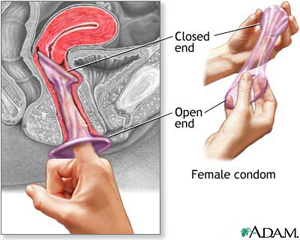
FEMALE CONDOM
Putting on the Condom
Open the package carefully and choose a comfortable position for insertion. You may want to lie down, squat, raise one leg or sit.
Make sure the condom is lubricated enough. You can add lubrication inside the condom or to the penis. Female condoms are polyurethane; so oil-based lubricants can be used.
The inner ring should be at the bottom closed end of the sheath. Hold the sheath with the open end hanging down.
Squeeze the inner ring with your thumb and middle finger. This will make it long and narrow.
Insert the inner ring into the vagina and feel it go up. Place your index finger inside the condom and push the inner ring as far as it will go. Make sure the condom is not twisted.
The outer ring should remain outside the vagina. The penis should be guided into the condom to ensure it doesn't slip into the vagina during intercourse.
Use enough lubricant so the condom stays in place during sex.
Removing the female Condom
Remove before standing up. Squeeze and twist the outer ring. Pull it out gently keeping the semen inside.
Wrap the condom in its original package or a tissue and throw it away. Avoid flushing it down the toilet.
YUMA, Ariz. – Inspectors have found small, subsurface cracks in three more Southwest Airlines planes that are similar to those suspected of causing a jetliner to lose pressure and make a harrowing emergency landing in Arizona, a federal investigator said Sunday.
Southwest said in statement that two of its Boeing 737-300s had cracks and will be evaluated and repaired before they are returned to service. A National Transportation Safety Board member told The Associated Press later Sunday that a third plane had been found with cracks developing.
The cracks found in the three planes developed in two lines of riveted joints that run the length of the aircraft. Nineteen other Boeing 737-300 planes inspected using a special test developed by the manufacturer showed no problems and will be returned to service. Checks on nearly 60 other jets are expected to be completed by late Tuesday, the airline said.
That means flight cancelations will likely continue until the planes are back in the air. About 600 flights in all were canceled over the weekend.
NTSB board member Robert Sumwalt said Boeing was developing a "service bulletin" for all 737-300 models with comparable flight cycle time as the Arizona jet, which was 15 years old and had about 39,000 takeoff and landing cycles.
There are 931 such models in service worldwide, 288 of which in the U.S. fleet. Boeing's bulletin would strongly suggest extensive checks of two lines of "lap joints" that run the length of the fuselage. The NTSB has not mandated the checks, but Sumwalt said the FAA will likely make them mandatory.
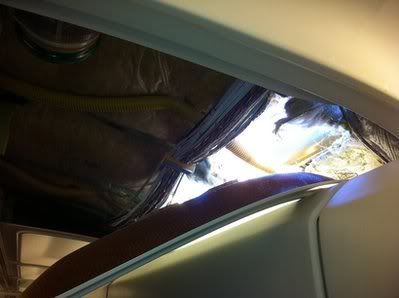
Friday's flight carrying 118 people rapidly lost cabin pressure after the plane's fuselage ruptured — causing a 5-foot-long tear — just after takeoff from Phoenix.
Passengers recalled tense minutes after the hole ruptured overhead with a blast and they fumbled frantically for oxygen masks. Pilots made a controlled descent from 34,400 feet into a southwestern Arizona military base. No one was seriously injured.
The tear along a riveted "lap joint" near the roof of the Boeing 737 above the midsection shows evidence of extensive cracking that hadn't been discovered during routine maintenance before the flight — and probably wouldn't have been unless mechanics specifically looked for it — officials said.
"What we saw with Flight 812 was a new and unknown issue," Mike Van de Ven, Southwest executive vice president and chief operating officer, said. "Prior to the event regarding Flight 812, we were in compliance with the FAA-mandated and Boeing-recommended structural inspection requirements for that aircraft."
Sumwalt said that the rip was a foot wide, and that it started along a joint where two sections of the plane's skin are riveted together. An examination showed extensive pre-existing damage along the entire tear.
The riveted joints that run the length of the plane were previously not believed to be a fatigue problem and not normally subjected to extensive checks, Sumwalt said.
"Up to this point only visual inspections were required for 737s of this type because testing and analysis did not indicate that more extensive testing was necessary," Sumwalt said. That will likely change after Friday's incident, he said.
The FAA declined to say if it was requiring other operators to check their aircraft for similar flaws.
The NTSB also could issue urgent recommendations for inspections on other 737s if investigators decide a problem has been overlooked. The agency's investigation has not determined that the cracks caused the rupture, but it is focused on that area.
Federal records show cracks were found and repaired a year ago in the frame of the same Southwest plane.
A March 2010 inspection found 10 instances of cracking in the aircraft frame, which is part of the fuselage, and another 11 instances of cracked stringer clips, which help hold the plane's skin on, according to an AP review of FAA records of maintenance problems for the Arizona plane.
The records show the cracks were either repaired or the damaged parts replaced. Cracking accounted for a majority of the 28 problem reports filed as a result of that inspection. It's common for fuselage cracks to be found during inspections of aging planes, especially during scheduled heavy-maintenance checks in which planes are taken apart so that inspectors can see into areas not normally visible.
The Arizona jetliner had gone through about 39,000 cycles of pressurizing, generally a count of takeoffs and landings. Cracks can develop from the constant cycle of pressurizing for flight, then releasing the pressure.
Southwest officials said it had undergone all inspections required by the FAA. They said the plane was given a routine inspection Tuesday and underwent its last so-called heavy check, a more costly and extensive overhaul, in March 2010.
The decompression happened about 18 1/2 minutes after takeoff from Phoenix Sky Harbor International Airport after the pilots reached their cruising altitude. They immediately donned their oxygen masks, declared an emergency and briefly considered returning to Phoenix before the cabin crew told them of the extent of the damage, Sumwalt said.
"They discussed landing in Phoenix, but quickly upon getting the assessment decided to divert to Yuma because it was the closest suitable airport," he said.
The plane's voice and data recorders were being examined in Washington, and Sumwalt said they worked well and showed no sign of a problem before the incident. Southwest operates about 170 of the 737-300s in its fleet of 548 planes, but it replaced the aluminum skin on many of the 300s in recent years, a spokeswoman said. The planes that were grounded over the weekend have not had their skin replaced.
Southwest said "based on this incident and the additional findings, we expect further action from Boeing and the FAA for operators of the 737-300 fleet worldwide." Boeing did not immediately return messages left Sunday. US Airways' website shows that the Arizona-based airline also operates 737-300s, but it did not immediately respond to a call from the AP.
In July 2009, a football-sized hole opened up in-flight in the fuselage of another of Southwest's Boeing 737s, depressurizing the cabin. Sumwalt said the two incidents appeared to be unrelated.
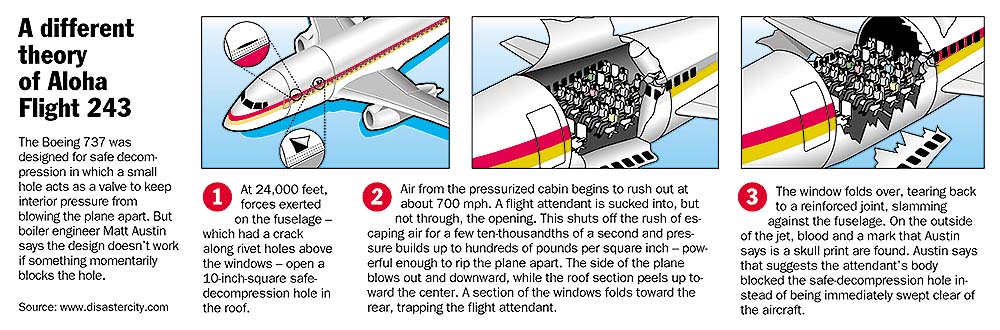
So what could of happened?
Aloha Airlines Flight 243 was a scheduled Aloha Airlines Boeing 737-200 flight between Hilo and Honolulu in Hawaii. On April 28, 1988, the aircraft suffered extensive damage after an explosive decompression in flight, but was able to land safely at Kahului Airport on Maui. One crew member was blown out of the airplane and another 65 passengers and crew were injured. The extent of the damage was only just below that which would have caused the airliner to break up, and the survival of the aircraft with such a major loss of integrity was unprecedented and remains unsurpassed.
Below are actual photo's of the plane after it's "Miracle Landing":