
What's happening in America today from a Generation X|Y point of view.
Showing posts with label hiv. Show all posts
Showing posts with label hiv. Show all posts
Thursday, May 11, 2023


Sunday, October 16, 2011
Lead the Way SD is the World's 1st Comprehensive "Test and Treat" model of HIV Prevention

"Would you or wouldn't you take an HIV test?"
For more info visit:
http://LeadTheWaySD.com
http://facebook.com/LeadthewaySD
http://twitter.com/LeadthewaySD
Sunday, August 14, 2011
PENN Medicine Researchers use HIV virus to kill leukemia cancer cells
The HIV virus may be about to become a new weapon in the fight against cancer as initial tests have shown it can drastically minimize and even help cure the most common form of leukemia.
A research team, led by Dr. Carl June working out of the Abramson Cancer Center at the University of Pennsylvania, has been experimenting with using a harmless version of the HIV virus combined with genetically modified white blood cells as a new way to fight cancer. The cells are taken from patients and modified with new genes that make them target cancer cells, but just as importantly, they can also multiply once injected allowing them to scale up as a small army inside the body.
Usually leukemia is treated with medication, chemotherapy, radiation therapy, and in some cases bone marrow transplants, all of which can have side effects and complications. This new treatment involves a single injection and the modified white blood cells do the rest of the work. If the same results seen in these first 3 patients are mirrored across a larger group it could signal a huge step forward in the treatment of a disease that currently kills hundreds of thousands of adults and children every year.
The results of the pilot trial of three patients are a stark contrast to existing therapies for CLL. The patients involved in the new study had few other treatment options. The only potential curative therapy would have involved a bone marrow transplant, a procedure which requires a lengthy hospitalization and carries at least a 20 percent mortality risk -- and even then offers only about a 50 percent chance of a cure, at best.
"Most of what I do is treat patients with no other options, with a very, very risky therapy with the intent to cure them," says co-principal investigator David Porter, MD, professor of Medicine and director of Blood and Marrow Transplantation. "This approach has the potential to do the same thing, but in a safer manner."
Secret Ingredients
June thinks there were several "secret ingredients" that made the difference between the lackluster results that have been seen in previous trials with modified T cells and the remarkable responses seen in the current trial. The details of the new cancer immunotherapy are detailed in Science Translational Medicine.
After removing the patients' cells, the team reprogrammed them to attack tumor cells by genetically modifying them using a lentivirus vector. The vector encodes an antibody-like protein, called a chimeric antigen receptor (CAR), which is expressed on the surface of the T cells and designed to bind to a protein called CD19.
Once the T cells start expressing the CAR, they focus all of their killing activity on cells that express CD19, which includes CLL tumor cells and normal B cells. All of the other cells in the patient that do not express CD19 are ignored by the modified T cells, which limits side effects typically experienced during standard therapies.
The team engineered a signaling molecule into the part of the CAR that resides inside the cell. When it binds to CD19, initiating the cancer-cell death, it also tells the cell to produce cytokines that trigger other T cells to multiply -- building a bigger and bigger army until all the target cells in the tumor are destroyed.
Serial Killers
"We saw at least a 1000-fold increase in the number of modified T cells in each of the patients. Drugs don't do that," June says. "In addition to an extensive capacity for self-replication, the infused T cells are serial killers. On average, each infused T cell led to the killing of thousands of tumor cells – and overall, destroyed at least two pounds of tumor in each patient."
The importance of the T cell self-replication is illustrated in the New England Journal of Medicine paper, which describes the response of one patient, a 64-year old man. Prior to his T cell treatment, his blood and marrow were replete with tumor cells. For the first two weeks after treatment, nothing seemed to change. Then on day 14, the patient began experiencing chills, nausea, and increasing fever, among other symptoms. Tests during that time showed an enormous increase in the number of T cells in his blood that led to a tumor lysis syndrome, which occurs when a large number of cancer cells die all at once.
By day 28, the patient had recovered from the tumor lysis syndrome –– and his blood and marrow showed no evidence of leukemia.
"This massive killing of tumor is a direct proof of principle of the concept," Porter says.
The Penn team pioneered the use of the HIV-derived vector in a clinical trial in 2003 in which they treated HIV patients with an antisense version of the virus. That trial demonstrated the safety of the lentiviral vector used in the present work.
The cell culture methods used in this trial reawaken T cells that have been suppressed by the leukemia and stimulate the generation of so-called "memory" T cells, which the team hopes will provide ongoing protection against recurrence. Although long-term viability of the treatment is unknown, the doctors have found evidence that months after infusion, the new cells had multiplied and were capable of continuing their seek-and-destroy mission against cancerous cells throughout the patients’ bodies.
Moving forward, the team plans to test the same CD19 CAR construct in patients with other types of CD19-positive tumors, including non-Hodgkin's lymphoma and acute lymphocytic leukemia. They also plan to study the approach in pediatric leukemia patients who have failed standard therapy. Additionally, the team has engineered a CAR vector that binds to mesothelin, a protein expressed on the surface of mesothelioma cancer cells, as well as on ovarian and pancreatic cancer cells.
Read the official Penn Medicine PRESS RELEASE here.
Friday, June 24, 2011
AHF How To Use a Condom: A Step by Step Guide with VIDEO Illustration





The MALE Condom
Naturally, the more you use a condom, the more confident you'll become with putting it on. Practice alone or with your partner, It can be fun, loving, and sexy thing you can learn together.

Putting on a Condom
- Carefully open the condom package at one corner being careful not to tear the condom with your fingernail, teeth or a sharp object.
- Place the rolled condom over the tip of the hard penis. If there is no reservoir tip, pinch it to give it one and leave room to let semen collect.
- If you’re not circumcised, pull back the foreskin before putting the condom on the head of your penis.
- Pinching the air out of the condom with one hand (air bubbles can cause breakage), unroll the condom down the full length of your penis to the base with the other.
- Make sure the condom is right side out. Unroll it a bit to see if it unrolls easily. If so, you’re doing it right. If not, try again with a new condom. You just need a little practice.
- For anal intercourse, lube up! Put the lube on after you put on the condom. It can actually reduce breakage. Always use check lubricants to see if they are safe to use with latex condoms.

Removing the Condom
- Pull out of your partner before the penis softens.
- Hold the condom firmly at the base of the penis at the rim so it doesn't slip off.
- Remove the condom being careful not to the spill the semen.
- Dispose of the condom by wrapping it in a tissue and throwing it way. Avoid flushing it down the toilet.
- Wash your hands with soap and water.
FEMALE CONDOM
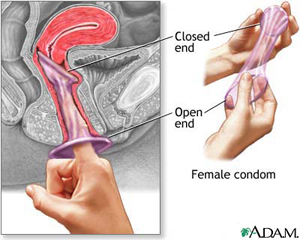
- Open the package carefully and choose a comfortable position for insertion. You may want to lie down, squat, raise one leg or sit.
- Make sure the condom is lubricated enough. You can add lubrication inside the condom or to the penis. Female condoms are polyurethane; so oil-based lubricants can be used.
- The inner ring should be at the bottom closed end of the sheath. Hold the sheath with the open end hanging down.
- Squeeze the inner ring with your thumb and middle finger. This will make it long and narrow.
- Insert the inner ring into the vagina and feel it go up. Place your index finger inside the condom and push the inner ring as far as it will go. Make sure the condom is not twisted.
- The outer ring should remain outside the vagina. The penis should be guided into the condom to ensure it doesn't slip into the vagina during intercourse.
- Use enough lubricant so the condom stays in place during sex.

Removing the female Condom
- Remove before standing up. Squeeze and twist the outer ring. Pull it out gently keeping the semen inside.
- Wrap the condom in its original package or a tissue and throw it away. Avoid flushing it down the toilet.
- Wash your hands with soap and water.
Wednesday, June 15, 2011

Tuesday, May 17, 2011


Subscribe to:
Posts (Atom)