When Bob Stansel and Tammy Marek were planning their new luxury home here in the Hamptons, they didn't want to overwhelm the neighbors. So they buried half of it.
Except for its arching corrugated metal roof, the unadorned modern structure built of concrete and glass barely rises higher than the grassy slope into which it's built. More than 3,200 of the four-bedroom home's roughly 6,400 square feet are located in a lower level, making the house appear more than twice as big from the side as it does from the front.
Using subterranean construction to avoid restrictive building codes is a popular option in places like California's Napa Valley, where home owners burrow underground for more space. But the couple here said their decision wasn't driven by regulations; instead it was their own desire for a pared-down aesthetic.
"I don't think I'd want people thinking that was my dream of retirement, to build some monster," said Mr. Stansel, a 65-year-old former mortgage banker who moved into the East Hampton home with his wife this winter. "We didn't want a bunch of expensive decorations on the outside."
On the property, Japanese maple and copper beech trees sit near a planted flat-roofed garage and grass driveway whose wide-set cobblestones look like part of the landscaping. Mr. Stansel took a 1,200-pound glacial rock, which he bought for $2,000 after becoming intrigued by its Alaska history, and trucked it from storage in Portland, Ore. to use outside as a garden feature.
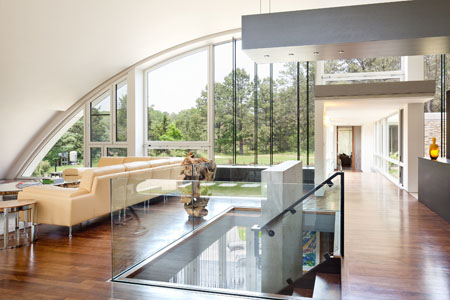 |
| The owners filled the home with pieces chosen by an interior decorator. |
Downstairs, a sitting area and den are lit by three pairs of 9-foot tall glass French doors around a lower courtyard. Mr. Stansel's study and a general storage area, however, are in rooms without any direct light. Architects are seeing more houses with unassuming façades that explode in size when viewed from the back, or homes split into multiple buildings so they'll look less massive, or even homes that New York architect Lee Skolnick calls "McRanchions"—1950s ranch houses given luxury makeovers. "There's a trend we're seeing—it's called 'perceived thrift,'" said Chris Rose, an architect based in Charleston, S.C. "It's kind of like the ladies going to Bergdorf's and still buying stuff, but putting it in a brown bag."
Mr. Stansel had his fill when it came to towering properties: In 2009, he and Ms. Marek bought Canterbury Castle, a 1930s landmark in Portland, Ore. with a moat, drawbridge and turret, for about $290,000. They were already living in the house next door and bought the site as an investment. The city had deemed the crumbling edifice structurally unsound, clearing the way for the couple to raze it. Some locals were opposed, but the couple considered it unsafe and an eye sore.

The couple moved to New York because they thought it would make it easier to travel to Europe in their retirement, though they are considering spending the winters in Portland if they don't find a buyer for their property there. Outside their Long Island home, a memento from their Portland past is now set into the ground. Two heavy stones serve as steps to a soon-to-be-built Zen garden—pieces of the castle they once owned.